
Every successful organisation needs someone who is willing to ask difficult questions. Every business needs auditors.Every institution needs checks and balances. Every family grows when different opinions are heard and respected.
Then why should a nation be any different?
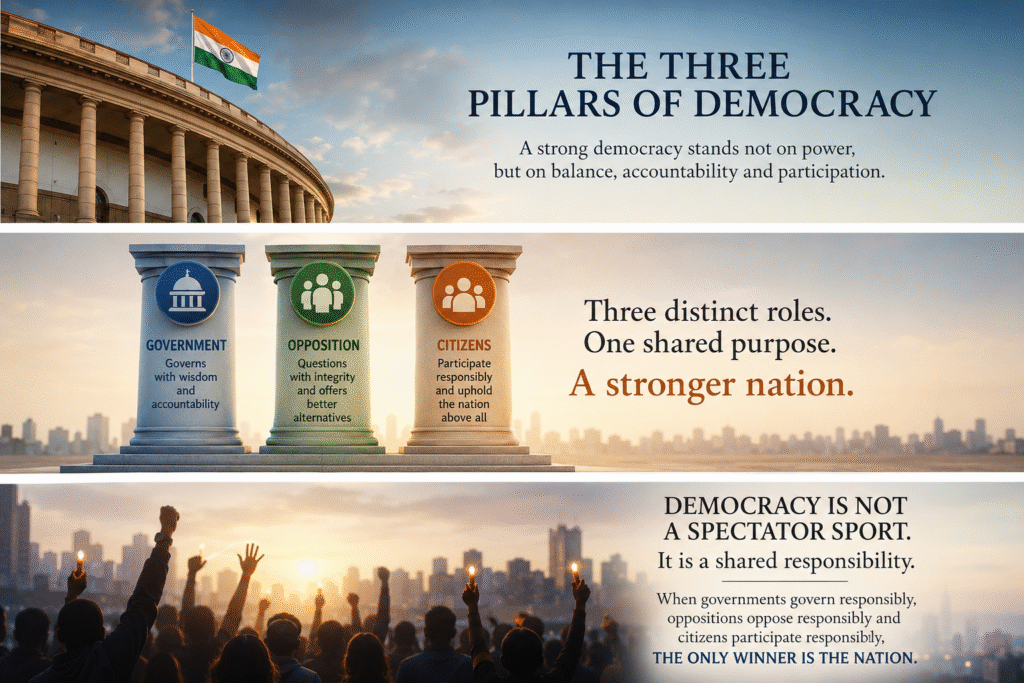
A democracy does not merely require a government. It requires three equally important pillars—a responsible government, a constructive opposition and informed, responsible citizens. Each has a distinct role, yet all share one common purpose: to strengthen the nation. When any one of these pillars weakens, democracy itself is weakened.
Unfortunately, in many democracies today, opposition is increasingly being mistaken for obstruction. Criticism has become an end in itself rather than a means to improve governance. Every decision is viewed through a political lens. Every achievement is questioned. Every mistake becomes an opportunity for political gain.
This raises an important question.
What is the true purpose of an opposition?
The Role of the Opposition
One of the greatest misconceptions in politics is that the ruling party and the opposition are enemies.
They are not.
They are two groups entrusted with different responsibilities but united by one common purpose—the welfare and progress of the nation. The government is elected to govern. The opposition is elected to question, scrutinise and ensure that governance remains transparent, accountable and responsive to the people.
Both ultimately serve the same citizens.
When politics becomes a contest of egos rather than a commitment to public service, democracy begins to lose its balance.
More importantly, politics should never become personal. In a healthy democracy, leaders may strongly oppose policies, decisions and ideologies, but they should never allow personal animosity to become the driving force behind public action. The moment politics becomes about defeating individuals instead of solving national problems, the nation begins to pay the price.
Citizens do not elect leaders to settle personal scores. They elect them to improve their lives.
Political competition should end where the nation’s interest begins.
The question should never be,
“How do we defeat them?”
It should always be,
“How do we make our nation stronger?”
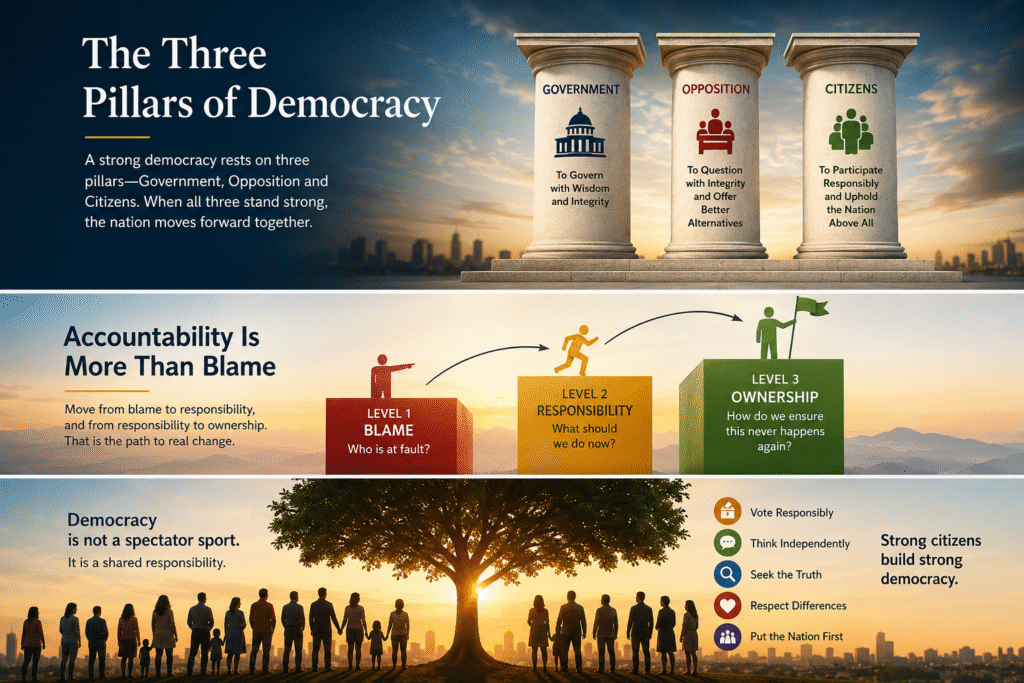
Accountability Is More Than Blame
Perhaps no word in public life is more misunderstood than accountability. For many people, accountability simply means finding someone to blame. But blame and accountability are not the same.
In reality, accountability has three distinct levels.
Level 1 – Blame
The first level asks, “Who is at fault?”
Its objective is to identify mistakes and assign blame. It creates defensiveness. It encourages finger-pointing. It generates headlines.
But very little changes.
Level 2 – Responsibility
The second level asks, “What should we do now?”
The focus shifts from fault to action. Instead of asking who failed, responsible leaders ask, “How do we correct this?” “What have we learned?” “How do we improve?”
This is where progress begins.
Level 3 – Ownership
The highest level asks, “How do we ensure this never happens again?”
Ownership is not satisfied with solving today’s problem. It improves systems. It strengthens institutions. It builds a better future.
This is where transformational leadership begins.
A weak opposition government & citizens remains at Level 1, where every discussion revolves around blame.
A responsible opposition government & citizens operates at Level 2, identifying problems while proposing meaningful solutions.
A statesmanlike opposition government & citizens reaches Level 3, helping build stronger institutions and better governance for future generations.
True accountability is not about humiliation. It is about responsibility.
It is not about strengthening political positions. It is about strengthening institutions.
Blame looks backward. Accountability looks forward.
The Responsibilities of a Constructive Opposition
A responsible opposition performs several vital functions.
I. First, it holds the government accountable. It asks difficult questions, demands transparency, exposes corruption where evidence exists and ensures that power is exercised responsibly.
II. Second, it provides constructive criticism. Constructive criticism has three essential ingredients.
- It is fact-based, not emotion-based.
- It identifies what is wrong.
- Most importantly, it offers a better alternative.
Criticism without facts creates confusion. Criticism without solutions creates frustration. Constructive criticism creates progress.
III. Third, opposition must offer alternatives. It is easy to identify problems. Leadership begins when solutions are presented.
Citizens deserve more than hearing, “This is wrong.” They deserve to hear, “Here is a better way.”
Finally, national interest must always remain above political interest. During times of national crisis, natural disasters, economic challenges or matters of national security, political differences may continue, but the nation must remain united.
The role of the opposition is not to oppose the government. Its role is to oppose anything that is not in the interest of the nation.
That is a profound difference.
Respectful Debate Is the Lifeblood of Democracy
Democracy thrives on debate. It does not thrive on personal attacks, shouting matches or attempts to silence opposing voices. Different opinions are not dangerous.
Disrespect is.
Progress has always emerged from thoughtful discussion, careful listening and a willingness to reconsider one’s own position. A mature democracy welcomes disagreement because it recognises that no individual or political party possesses all the answers.
Respect does not weaken convictions. It strengthens them.
The Role of Government
Accountability is not a responsibility reserved only for the opposition. Governments are equally accountable. A confident government welcomes scrutiny rather than fears it. It remains transparent. It acknowledges mistakes when necessary. It remains open to suggestions. It understands that criticism offered in good faith is an opportunity to improve, not a threat to authority.
Power should never become arrogance. Leadership should never become unquestionable. Constructive opposition makes governments better. Wise governments understand this.
The Role of Citizens
It is easy to expect more from governments. It is easy to expect more from the opposition. The more difficult question is this:
What kind of citizens are we becoming?
A democracy cannot be stronger than its citizens. Governments are elected by citizens. Oppositions are elected by citizens. Public discourse is shaped by citizens. The quality of leadership we experience is often a reflection of the standards we are willing to accept. If we reward division, we will receive more division. If we reward shouting, we will hear more shouting. If we reward misinformation, misinformation will flourish. But if we reward integrity, respectful debate, competence and solutions, politics will gradually begin to reflect those values.
Democracy is not a spectator sport. It is a shared responsibility. Every citizen has a vote. Every citizen has a voice. Every citizen has a responsibility.
Perhaps before asking, “What is wrong with our politicians?”we should also ask, “What kind of citizens are we?”
Do we verify facts before forwarding messages? Do we listen before judging? Do we encourage thoughtful discussion? Do we vote responsibly? Do we evaluate leaders by their performance rather than by our personal preferences?
The strength of a democracy does not begin in Parliament. It begins in our homes.
Around our dining tables. In our workplaces. On social media. In the conversations we have with our children. The future of a nation is shaped long before a vote is cast.
It is shaped by the values its citizens choose to live every day.
Conclusion
A strong democracy is never built by governments alone. Nor by the opposition alone. Nor by citizens alone. It flourishes only when all three pillars fulfil their responsibility.
The first pillar is a government that governs with wisdom, humility and transparency.
The second pillar is an opposition that questions with integrity, offers constructive criticism and presents better alternatives.
The third pillar is a citizenry that thinks independently, participates responsibly, demands accountability and always places the nation above personal or political loyalties.
When any one of these pillars weakens, democracy becomes fragile. When all three stand strong, democracy becomes resilient. The true purpose of government is not to defeat the opposition. The true purpose of opposition is not to weaken the government. The true purpose of citizens is not merely to vote, but to uphold the values upon which democracy rests.
Governments may change. Oppositions may change. Political parties may come and go.
But the nation must always come first.
Because when governments govern responsibly, oppositions oppose responsibly and citizens participate responsibly, there are no winners or losers in politics.
The only winner is the nation.
This is an amazing blog—well-written, engaging, and full of valuable insights.
The content is easy to understand, informative, and keeps the reader interested from beginning to end.
Keep up the excellent work!
Thank you Rajeev sir for your encouraging words. And the conversation we had layerr. It means a lot. Do share the blog freely.