
“Education is not the filling of a pail, but the lighting of a fire.”
— Often attributed to William Butler Yeats
India has one of the largest education systems in the world. Millions of children enter classrooms every morning. Parents invest their savings. Teachers dedicate their lives. Governments introduce new policies. Coaching institutes flourish. Universities produce graduates by the millions.
Yet one uncomfortable question refuses to go away.
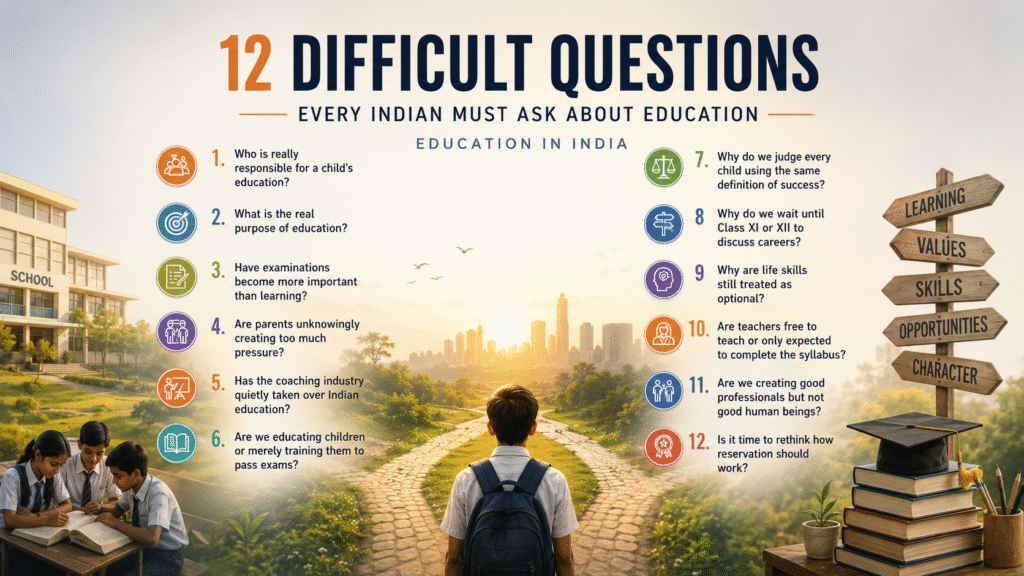
Are we truly educating our children… or are we simply preparing them to clear the next examination?
This article does not claim to have the answers. It simply asks twelve questions that, perhaps, we have avoided for far too long.
1. Who is really responsible for a child’s education?
Parents blame schools. Schools blame parents. Students blame teachers. Teachers blame the system. Governments blame previous governments. Coaching institutes blame schools. Everyone has an explanation. Very few accept responsibility. Perhaps the first lesson we need to teach is that education is a shared responsibility.
2. What is the real purpose of education?
Is education meant to get a job? Or To create responsible citizens?
To build character? Or To develop innovators?
To reduce poverty? Or To strengthen democracy?
Or to help people live meaningful lives?
Until we answer this clearly, every reform will only fix symptoms, not the real problem.
3. Have examinations become more important than learning?
A student who scores 98% is celebrated. A student who asks good questions is often ignored.
Marks have become the goal. Learning has become secondary.
Exams have also changed learning into memorising answers instead of understanding ideas. Students are trained to repeat, not to think deeply. Real education must include both—clear knowledge and real understanding—where questioning is encouraged and thinking is developed.
If exams disappeared tomorrow, would children still enjoy learning?
4. Are parents unknowingly becoming the biggest source of pressure?
Every parent wants the best for their child. That is natural. But sometimes, love slowly turns into pressure. Children start carrying not just school bags. They carry expectations. Comparison. Fear of failure.
Pressure to achieve dreams that may not even be theirs.
At the same time, there is also a strong focus on material success—status, salary, and social image. Material success matters, but the real question is: how much is enough?
How many careers are chosen by children themselves?
And how many are chosen by parents?
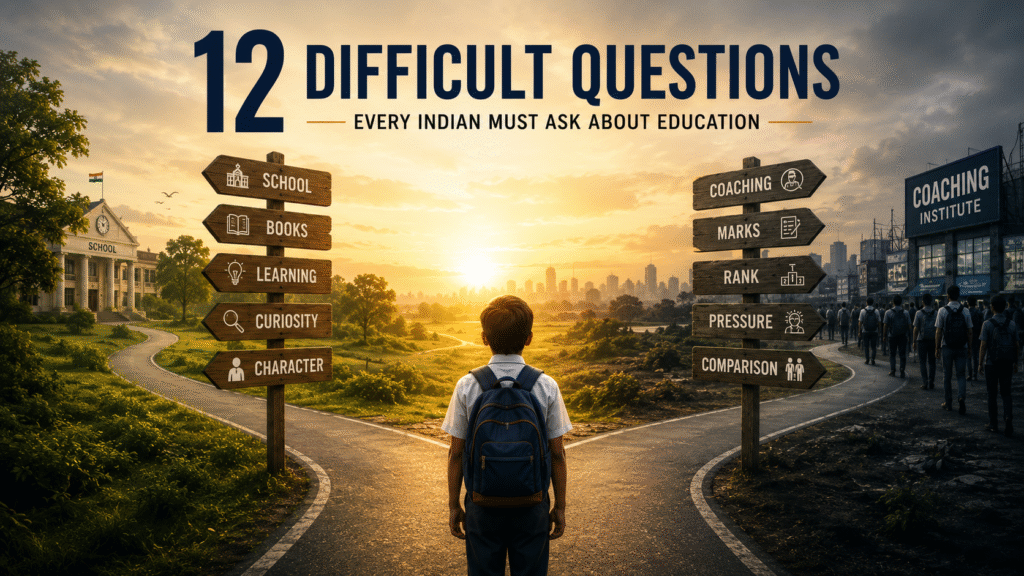
5. Has the coaching industry quietly taken over Indian education?
There was a time when schools were the main place of learning. Today, for many students preparing for competitive exams, coaching centres have become the real classroom. Some students go to school only for attendance. Others spend more time in coaching than in school. I have personally heard coaching institutes tell students to reduce college attendance because it affects exam preparation.
Even if this is not everywhere, even the possibility should make us think. If students feel real learning happens outside school, we must not only question coaching centres. We must also ask what has happened to our schools and colleges.
This shift is not just about studies—it is changing childhood itself, turning education into a race instead of a journey of learning.
6. Are we educating children… or just training them to pass exams?
Memorising is not the same as understanding. Understanding is not the same as applying. Applying is not the same as thinking. Thinking is not the same as wisdom.
Education should develop all four.
7. Why do we measure every child using the same definition of success?
One child loves mathematics. Another loves music. Another fixes machines. Another writes well. Another leads naturally. Another serves quietly.
Yet we still compare all of them using the same academic system.
Can one report card really show human potential?
8. Why are life skills still treated as optional?
Communication. Financial literacy. Relationships. Mental health. Conflict resolution. Decision-making. Ethics. Leadership. Time management.
These are not extra activities. They are life itself.
Along with this, spirituality should also be introduced early—not religion, but spirituality as self-awareness, inner balance, and understanding one’s place in the world.
Shouldn’t education prepare us for living as much as it prepares us for earning?
9. Are we preparing children for a digital world—or letting the digital world shape them?
We often call technology a tool.
But for today’s child, it is not just a tool—it is the world they live in.
A world that never stops. A flow that never ends. A system designed to hold attention, not build focus. Social media promises connection, but often creates comparison. Technology promises knowledge, but often creates distraction. Slowly, children are losing the ability to sit quietly, think deeply, and stay focused.
The real problem is not that children use technology. The real problem is that technology is shaping them—without teaching them how to question it, control it, or step away from it.
If education does not build digital discipline, emotional awareness, and critical thinking, then we are not preparing children for the future.
We are simply handing them over to it.
10. Is our education system creating good professionals… but not necessarily good human beings?
A country needs engineers. Doctors. Scientists. Lawyers. Entrepreneurs.
But it also needs honesty. Compassion. Integrity. Responsibility. Humility.Respect for others.
These values are rarely measured in exams. Yet they decide the quality of families, workplaces, and society.
Today, in many fields, professions have become more business-focused, where earning often matters more than service.
This shift is not random—it is shaped by the values our education system promotes.
11. Is our education system quietly reducing the potential and intelligence of an entire generation?
India has no shortage of talent. Indian students and professionals consistently prove their ability to build, innovate, and compete globally. The question is not whether Indians are capable—the proof is already there. The question is why so much of this potential gets limited or lost within our system.
An exam-focused culture that values memorisation over thinking. A coaching-driven system that replaces curiosity with shortcuts. A rigid structure that values obedience over creativity. A learning space where risk-taking is discouraged and “right answers” matter more than original ideas.
Over time, this does not just reduce opportunity—it changes how young minds think. It teaches students to avoid uncertainty, fear failure, and focus on survival instead of exploration.
But there is another important issue: how political systems have often used education policies for control instead of real reform. Reservation, in particular, is sometimes treated not as a balanced social justice tool, but as a political instrument shaped by electoral needs. Instead of reducing division, it is often used in ways that increase it, shifting focus away from real educational improvement.
The result is a system where merit is debated more than developed, where opportunity is seen through identity, and where talent does not always get the space it deserves.
This is not about any one group or ideology. It is about a system where both education and politics have, over time, moved away from the true purpose of learning.
The hard truth is simple: India does not lack intelligence. It lacks enough environments where intelligence can fully grow.
12. If tomorrow you were asked to redesign India’s education system, what would you change first—and why?
Maybe the future of education will not come from a few experts.
It will come from millions of Indians who start asking better questions.
Because real change does not begin with policy.
It begins with a question that refuses to be ignored.