
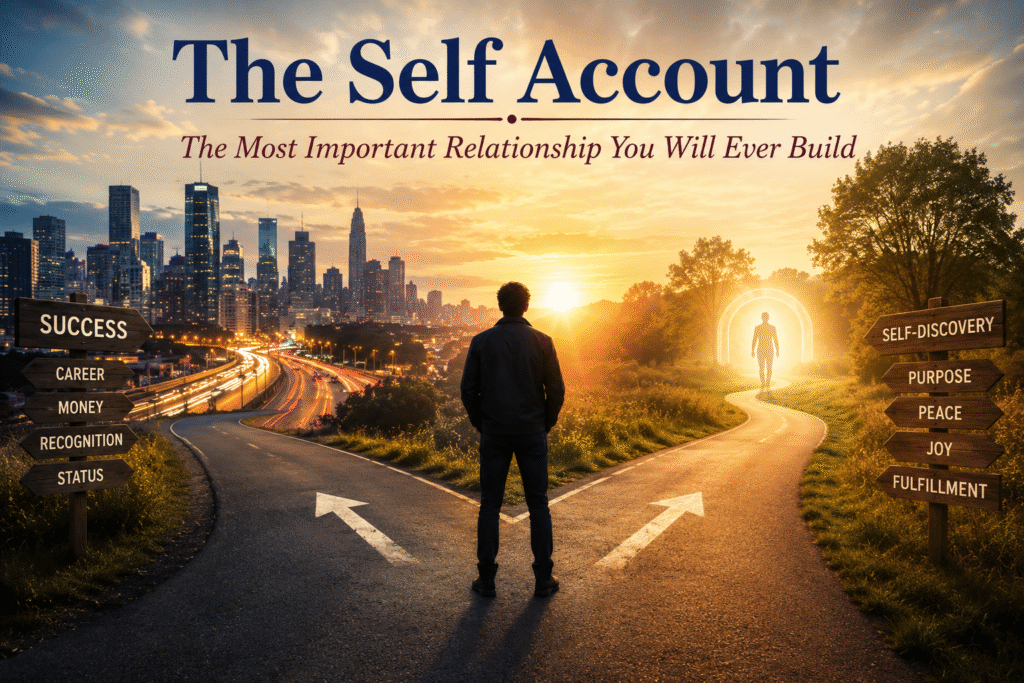
Why Success Means Very Little If You Don’t Know Yourself
Amit was doing everything right. Or at least that is what he believed.

A good job. A decent salary. A growing reputation. People admired him.
Yet, deep inside, he felt a vaccum, he could not explain it. There was no major crisis. No dramatic failure. No shortage of opportunities. Yet there was a quiet emptiness he could not ignore.
Today, many people live the same story. Some may be unaware of it, many are aware. What about you?
We spend years investing in our careers, building wealth, acquiring skills, chasing goals, and seeking approval. Yet we often neglect the one person who influences every decision we make.
Ourselves.
And that is where the Self Account begins.
The quality of your life is determined by the quality of your relationship with yourself.
The Most Difficult Person to Understand Is You
Most people believe they know themselves.

In reality, they know their achievements, job titles, responsibilities, likes, dislikes, successes, and failures.
But very few truly understand:
- Why do I think the way I think?
- Why do certain situations trigger me?
- Why do I keep repeating the same mistakes?
- Why do I behave differently under pressure?
- Why do I seek approval from certain people?
Self-awareness requires something most people avoid.
Honest self-confrontation.
It takes courage to look into the mirror and accept what you see.
Blaming is easier.
When we blame circumstances, society, our boss, our spouse, or our upbringing, we avoid responsibility. We protect our ego while sacrificing our growth.
The cost of not knowing yourself is far greater than most people realise.
It can cost you your happiness, relationships, peace of mind
And sometimes, it can cost you your life’s purpose.
My Search for a Worthy Ideal

Many years ago, I came across a definition of success by Earl Nightingale:
“Success is the progressive realisation of a worthy ideal.”
That definition stayed with me.
What is a worthy ideal?
How do you discover it?
And more importantly, is it worth searching for?
For me, these questions became deeply personal.
I came from a business family. Life was comfortable. There was decent money, a good home, and everything that most people would consider success. Yet there was a vacuum within. A question refused to leave me.
Why am I doing what I am doing?
That question led me on a journey that lasted almost fifteen years.
Through programs, Workshops, Exercises, Failures. Reflections, Moments of insight and countless moments of confusion.
Eventually, I discovered three simple words that changed my life:
“ Making a Difference “

What Changed After Discovering My Purpose?
Before discovering my worthy ideal, I spent a lot of time seeking approval, especially from my father. Like many people, I compared myself with others. I chased success the way society defines success. I worried about what people thought.
I wanted validation, recognition. I wanted to fit in.
Then something shifted.
The more I aligned my life with “Making a Difference,” the less important approval became.
Work stopped feeling like work. Long hours felt meaningful rather than stressful.
Money became a by-product rather than the primary goal.
In my sales presentations, I often said:
“If I help you make more money, I have already made mine.”
My focus shifted from getting to contributing.
From impressing to serving.
From comparison to purpose.
From achievement to fulfilment.
The more I focused on helping others get what they wanted, the more life seemed to provide what I needed.
Relationships improved. Peace increased. Joy became central.
Living a balanced life became my inner calling.
That is what success means to me today.
Your worthy ideal may be different. But until you discover it, you may spend years climbing a ladder only to discover it is leaning against the wrong wall.
The Difference Between Understanding and Experiential Learning
One of my mentors once said: “All intelligent people are not wise, but all wise people are intelligent.”
That statement stayed with me.
Wisdom is not information. Wisdom is applied information.
Many people believe transformation happens when they understand something.
I believe, Transformation happens when you experience something.
At LSU, we strongly believe in experiential learning.
Let me explain.
Imagine reading a sheet of paper titled: “Ten Steps to Ride a Bicycle.”

Will it teach you cycling?
Of course not.
You have to get on the bicycle. You have to wobble. You may fall. You may even hurt yourself.
Then suddenly, in a single moment, you discover “Balance.”
Can someone teach you balance? Can you teach it to someone?
Not really.
Because balance is not understanding.
Balance is an experience.
The same is true for confidence, Leadership, Self-love, Meditation, Responsibility, Purpose.
These are experiences.
Not concepts.
Information informs. Experience transforms.
Three Universal Coaching Principles That Changed My Life
Over the years, I have studied many models and frameworks.
Yet three principles have had the greatest impact on my life. I did not create them. They are universal laws.
Following are the Three Laws
1. What You Sow Is What You Reap
Whether it is a thought, action, habit, decison. They all create “conququences”
The seeds you plant today become the harvest you experience tomorrow.
2. What You See Outside Is Often A Reflection Of What Exists Within
This principle became real for me through an unforgettable experience. Let me share it here.
Many years ago, while riding my scooter to work in Mumbai, I saw a young man standing naked on a busy road while people around him were beating him.
The image disturbed me deeply. I could not focus on my work.
I called a close friend and described what I had seen.
After listening quietly, he asked me a simple question:
“Who did you really see?”
Note the question was not What did you see, it was Who did you see?
The question shocked me.
Suddenly, I realised what was disturbing me.
I had not merely seen that young man.
I had seen myself.
Emotionally exposed.
Emotionally vulnerable.
Emotionally stripped by the opinions and expectations of others.
At that moment, this principle stopped being an idea.
It became an experience.
3. How You Do Anything Is How You Do Everything
Excellence is never accidental.
Your behaviour in small things eventually becomes your behaviour in big things.
Integrity is not situational.
Discipline is not occasional.
Leadership is not a title.
The way you show up every day ultimately shapes your life.
These three principles changed my life
because they brought my locus of control back to where it belonged.
Within me.
The Power of Investing in Yourself
One of my mentors taught me a lesson I have never forgotten:
“People are not paid for the work they do. They are paid for the value they create.”
This changed everything.
Many people complain they are underpaid.
Very few ask:
How much value am I creating?
The marketplace rewards value.
The more problems you can solve, the more valuable you become.
Most people run away from responsibility.
I run towards it.
Why?
Because I see responsibility differently.
Many people interpret responsibility as a burden.
I interpret responsibility as my ability to respond.
The most powerful investment you can ever make is investing in yourself.
Every skill you learn. Every lesson you absorb. Every limitation you overcome. Every fear you conquer.
Adds value to your life and to the lives of others.
As another mentor once told me: “To Have More, Be More.” It is difficult to understand. But powerful to experience.
Remember Investing in Yourself is a Life Long Journey
Self-Love: The Foundation Most People Miss

Look into the mirror and ask yourself:
“Do I truly love myself unconditionally?”
Most people answer yes immediately.
But if we listen carefully to our inner dialogue, we discover a different reality.
We criticise ourselves.
Judge ourselves.
Compare ourselves.
Punish ourselves.
Doubt ourselves.
If someone else spoke to us the way we speak to ourselves, we would probably avoid that person.
Love is perhaps the most misunderstood word in society.
It is often confused with possession, control, dependency, obsession, or lust.
True love is different.
True love sets people free.
Self-love is not arrogance.
It is not selfishness.
It is not self-obsession.
It is accepting yourself completely, the way you are, while continuing to grow.
And the surprising truth is this:
The more you genuinely love yourself, the easier it becomes to love others.
Who Motivates the Motivator?

There is a voice inside your head that never sleeps. It is with you when you wake up. It is with you when you go to sleep. It comments on everything you do.
Your successes. Your failures. Your appearance. Your decisions. Your relationships. Your future.
The question is:
What is this voice saying to you?
What makes this inner dialogue even more interesting is that it is rarely a single voice. At different moments, different parts of us are speaking. One part wants comfort, another wants growth. One wants certainty, another wants adventure. One seeks recognition, another seeks meaning. This is why people often feel confused. In reality, they are not confused. Different parts of them want different things at the same time. Understanding these inner voices and learning when to listen to each one is an important part of self-discovery. Over the years, I have found that greater self-awareness comes not from controlling these voices but from understanding them.
Most people are completely unaware of their inner dialogue.
Yet this inner dialogue colours every experience of life. Imagine carrying a pair of glasses with blue lenses all day. Everything you see will appear blue. Your self-talk works exactly the same way.
If your inner dialogue constantly says:
- “I am not good enough.”
- “I always make mistakes.”
- “People don’t value me.”
- “I can’t do this.”
Then your mind starts treating these thoughts as reality.
On the other hand, if your self-talk says:
- “I am learning.”
- “I can handle this.”
- “There is a lesson here.”
- “I am becoming better every day.”
Then your life begins to move in a different direction.
One of the most powerful discoveries in my own life was that I am not my thoughts. I am the observer of my thoughts.
The moment I realised this, I stopped blindly believing everything that was happening inside my head.
Many people spend their lives trying to change their circumstances. Very few spend time changing the conversation that creates those circumstances.
Before you motivate a team, your family, your clients, or the people around you, you must learn how to motivate yourself.
And self-motivation begins with self-awareness.
Listen carefully to the conversations taking place inside your head.
They are quietly creating your future.
As Henry Ford famously said: “Whether you think you can, or you think you can’t, you’re right.”
Your inner dialogue is not just about your life.
It is helping create your life.
This is why the LSU module “Who Motivates the Motivator?” is so important. Click the link to watch the module on my Youtube Channel
The Forgotten Practice Called Me Time

In today’s hyperconnected world, people spend hours connected to everyone else and very little time connected to themselves.
Me Time is not a luxury.
It is a necessity.
For more than four decades, I have consciously created time to connect with myself.
I wake up at 3:30 a.m. I meditate. I write affirmations. I read. I practise Yoga. I reflect. My morning routine ends at arround 8.30 am. I sleep at 9.30 pm.
So much time completely with myself. No distractions. That’s precisely the morning routine starts 3.30 am.
This is “Early to bed early to rise makes a man healthy, wealthy and wise” in action
This routine did not happen overnight.
It evolved over years of work on myself.
Your version of Me Time may be different.
It may be walking. Reading. Meditating. Writing. Painting. Listening to music. Praying.
The activity is not important. The connection is.
Me Time nourishes your soul. Get your Me Time.
The quality of your relationship with yourself determines the quality of every other relationship in your life.
The Cost of Ignoring Your Self Account
When you neglect your Self Account:
- You seek approval instead of purpose.
- You compare instead of creating.
- You react instead of responding.
- You chase success but miss fulfilment.
- You live someone else’s definition of life.
The greatest tragedy is not failure.
The greatest tragedy is succeeding at something that was never truly important to you.
The Balance Sheet of Life Perspective
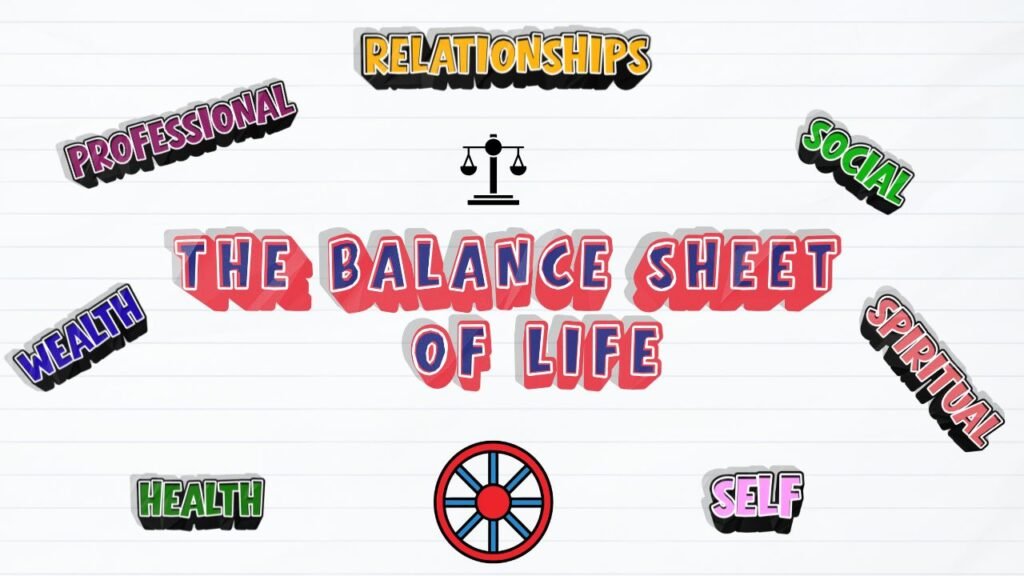
Many people spend decades building their Wealth Account and Professional Account while neglecting their Self Account.
Eventually, they discover an uncomfortable truth:
Success without self-awareness creates achievement but not fulfilment.
The Self Account is the foundation upon which every other account rests.
When you understand yourself better:
- Your relationships improve.
- Your decisions improve.
- Your confidence improves.
- Your leadership improves.
- Your life becomes more aligned.
The greatest journey is not discovering the world.
It is discovering yourself.
What Happened To Amit?
Amit’s problem was never a lack of money.
It was never a lack of opportunity.
It was never a lack of talent.
Amit’s problem was that he had spent years building every account in his life except the one account that influences all the others.
His Self Account.
The day Amit stopped asking:
“How can I become successful?”
and started asking:
“Who am I becoming?”
everything began to change.
His work improved.
His relationships improved.
His decisions improved.
Most importantly, his relationship with himself improved.
And that changed everything.
The truth is that Amit may not be a real person.
But his story is real.
Perhaps, somewhere in this article, you saw a little of yourself in him.
If you did, maybe it is time to begin the most important journey of all.
The journey inward.
Because the quality of your life is determined by the quality of your relationship with yourself.
Reflection Questions
- Why do I think the way I think?
- What part of myself am I resisting or avoiding?
- Which of the three coaching principles do I need most right now?
- What experience has taught me more than any book ever could?
- What can I do this week to invest in myself?
- Do I truly love and accept myself?
- What activity enriches my soul and deserves more time in my life?
PAP (Personal Action Plan)

Basic
Spend 15 minutes daily in uninterrupted Me Time.
Intermediate
Write down one lesson each day about yourself and your behaviour.
Advanced
Identify one limiting pattern in your life and consciously work on changing it over the next 30 days.
ROI (Return on Investment)

The return on investing in your Self Account is not measured only in money.
It appears as:
- Better decisions
- Greater emotional stability
- Improved relationships
- Higher self-confidence
- Increased resilience
- Greater clarity of purpose
- A deeper sense of fulfilment
And that may be the most valuable return of all.
Great insights. Very close to individual reality. Sounds tough on surface to reflect on but definitely doable. The article just elaborated basics on individual existence and happiness