
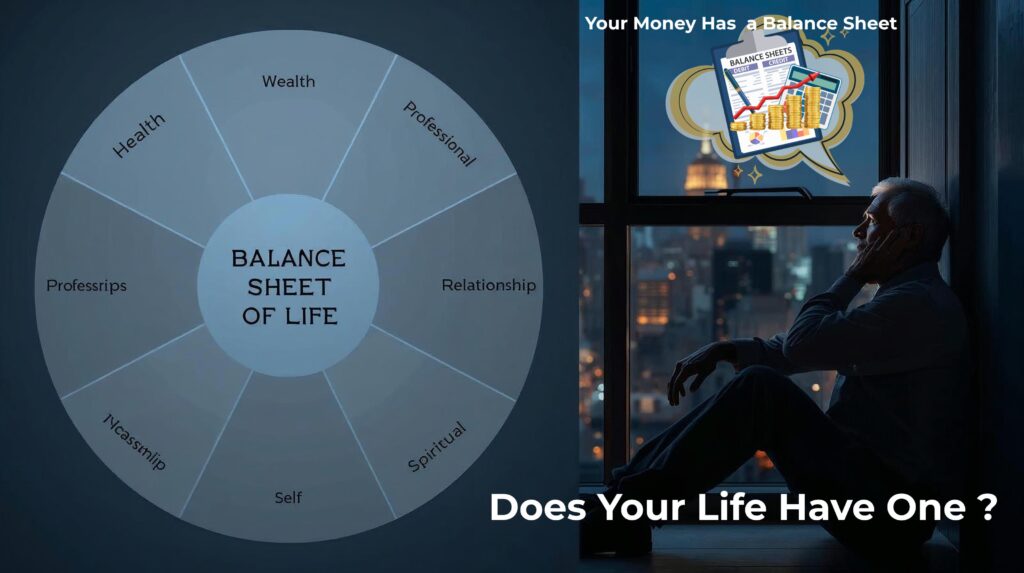
Not Just Your Money
Ramesh is not a careless man. If someone had to describe him, they would simply say that he is a good man—responsible, dependable, and hardworking. He is the kind of person every family feels safe with and every organisation relies on. In many ways, he represents a life most people are trying to build. In fact, if you pause for a moment, you may find parts of him in your own life.
His life is not extraordinary, but it is stable. He earns well, his children are doing fine, and he has a house that came after years of disciplined effort. At work, he is respected, and people trust his decisions. From the outside, nothing seems to be missing. Everything appears to be in place, exactly the way it should be.



But life rarely changes loudly. It does not announce its shifts. It moves quietly, almost politely, and if you are not paying attention, you may not even notice when the change begins. For Ramesh, it started with small things. His sleep became irregular, meals lost their discipline, and exercise slowly disappeared from his routine. At home, conversations became shorter—not because he did not care, but because his mind was always occupied with something else.
He was present physically, but not really there. His phone demanded attention, his thoughts ran constantly, and his stress had quietly taken a permanent seat in his life. Without realising it, “busy” had become his identity. His friends stopped insisting on meeting him because they already knew the answer. His family adjusted, as families often do. And Ramesh, like many of us, told himself that this is how life is supposed to be.
The truth is, life rarely breaks suddenly. Before every major collapse, life usually gives small warnings. A little tiredness. Irritation. Lack of sleep. Distance in relationships. Loss of peace. Reduced patience. But most people ignore these signals because they still appear functional from the outside.
That is the danger.
As long as life is still moving, we assume everything is fine.
And then one day, something happens—a health scare, a relationship crack, emotional burnout, a financial shock, or sometimes just an unbearable feeling of emptiness—and suddenly the same person who ignored the whispers is shaken awake by the noise.
Unfortunately, many people begin reviewing their life only after life forces them to stop.
The Moment Life Shook Him
For months, life had already been sending Ramesh warning signals. Poor sleep. Constant tiredness. Irritation without reason. Reduced patience. A growing distance in relationships. But like most people, he ignored them because he was still functioning. He was still going to work, still earning, still handling responsibilities. And as long as life continues to move, we assume everything is fine.
The truth is, life usually whispers before it shakes.



One evening, while returning from work, Ramesh suddenly felt a heaviness in his chest. At first, he ignored it. He assumed it was stress or acidity. But within minutes, he began sweating heavily, his breathing became uncomfortable, and panic slowly started rising inside him. Someone nearby noticed his condition and rushed him to a hospital.
Sitting alone in the emergency room, waiting for the reports, something inside him had already changed.
For the first time in years, his mind was not thinking about targets, meetings, money, or responsibilities. One question kept repeating itself quietly inside him:
“What have I been doing to myself?”
Fortunately, the reports did not show a major heart attack. The doctor later explained that it was a severe stress-related episode and an early warning sign. But the doctor also said something that stayed with him long after he returned home.
“Your body is warning you. The problem is not this incident. The problem is the life that is creating this incident.”
There was no drama in that sentence. Only truth.
And sometimes, truth hits harder than fear.
That night, Ramesh sat quietly in his living room long after everyone had gone to sleep. There was no television playing, no scrolling on his phone, and no attempt to distract himself. For the first time in a long time, he was not reviewing his finances, his career, or his responsibilities.
He was reviewing his life.
A Balance Sheet He Never Prepared
What surprised him was where his mind went. It did not go to his bank balance or his career plans. Instead, it moved towards his life as a whole. Almost unconsciously, he began to look at his life as if it were a balance sheet, but not the kind he was used to.
In this balance sheet, health was an account, relationships were an account, peace of mind was an account, and even self-respect had a place. As he sat with these thoughts, something felt uncomfortable. Nothing in his life was completely broken, yet something was clearly neglected.
He realised something simple but powerful.
We measure what is visible and ignore what is valuable.



That night, he did not make dramatic promises to himself. He did not decide to transform his life overnight. Instead, he chose something much simpler and far more powerful. He chose to look at his life honestly, without excuses or denial.
From that place, he made a few small corrections. He decided to take a short walk every day, keep his phone aside during dinner, and spend a few minutes each week quietly reviewing his life.
These actions were not impressive, but they were real.
For the first time, he was not reacting to life.
He was observing it.
The Results No One Tracks… But Everyone Feels
Over the next few weeks, nothing extraordinary happened. There were no dramatic breakthroughs or motivational movie moments. But there were small shifts.
He began sleeping a little better. His reactions softened. He found himself listening more and speaking less. At home, conversations felt easier. His family noticed that he was more present. At work, the pressure had not reduced, but his ability to handle it had improved. His mind was clearer, and his decisions felt calmer.
This is real ROI.
Not the kind we usually measure.
But the kind that quietly shapes the quality of our life.
Better health.
Better relationships.
Reduced emotional exhaustion.
More clarity.
More peace.
More self-respect.
These are invisible assets until the day you lose them.
Connecting to The Balance Sheet of Life
This is exactly what the Balance Sheet of Life is built around.
Most people prepare financial balance sheets but never prepare a life balance sheet. A financial balance sheet tells you how your money is doing. A life balance sheet tells you how you are doing.
It helps you see where your real assets are growing—health, relationships, clarity, discipline, peace of mind—and where hidden liabilities are silently building—stress, neglect, anger, poor habits, emotional exhaustion, and lack of direction.
A financial balance sheet protects your money.
A life balance sheet protects your future.
To understand the larger philosophy behind this work, you can explore more at Life Skills Unlimited
Connecting to The V.I.P. Impact Cycle
This is also where The V.I.P. Impact Cycle becomes practical.
Visibility means seeing your life clearly, without excuses.
Influence means understanding how your state affects the people around you.
Presence means showing up fully—at work, at home, and within yourself.
Many people are visible in the world but absent in their own life.
The moment Ramesh started reviewing his life honestly, he slowly started becoming present again.
If you wish to understand this framework deeper, explore The V.I.P. Impact Cycle
Reflection
Pause for a moment.
Not to analyse.
Just to notice.
If you honestly reviewed your life today, which area would quietly make you uncomfortable—not because it is wrong, but because it has been ignored for too long?
Closing
This is where the journey begins.
Not with motivation.
Not with pressure.
But with awareness.
In the coming week, we will explore one of the most neglected areas of modern life—
The Health Account
And understand what it is quietly trying to tell us.
For general health awareness and well-being guidance, you may also explore World Health Organization
Sounds very logical.
Agree, for those our age still working, things which we were doing effortlessly say 10 years ago, take much more effort.
In my case, in spite of the knowledge and experience gained over the past years the enthusiasm has reduced, especially because of more physical efforts needed to do the same things.
This induces stress.
Astute observations and insightful suggestions 🙏🏻
These posts are extremely well-written🌟💎